For practitioners who help CEOs grow

What you want from every engagement is two things.

Win the right ones, and see them through. The right ones are the ones where you can actually help: you know what the client really wants, and whether the plan can get him there, and you know it before you sign. Seeing them through matters because that’s where the real work happens: the results you can point to, the referrals that come from them, and (honestly) the reason most of us got into this in the first place.

A leader and an advisor side by side at a wooden table, both reading the same printed plan, a red notebook between them
A leader alone at his desk at dusk, reading a printed plan under a desk lamp
The problem

Right now, you can’t count on either.

Some engagements are exactly what they looked like in the pitch. Others look like a great fit in the sales conversation and turn out, four months in, to be something else. Some that should have lasted end early. Some you should never have taken.

It isn’t the quality of your work. Your work is good. Something upstream of it decides whether the engagement lives or dies, and right now you can’t see it.

Part of why you can’t: neither can your client. Nobody can deliver what a CEO wants if he hasn’t worked out what he wants himself, and the sales conversation is exactly where he’ll give you an answer he’s never tested against himself. He isn’t lying to you. He just hasn’t been asked the right questions yet.

PITCHSIGNEDMONTH 4MONTH 12 In the pitch, these are the same engagement. What it looked like in the pitch. Something else.
The cause

The part you control isn’t the part that decides.

The targeting, the messaging, the funnel, the campaigns (the work you’re hired for) decide less of an engagement’s outcome than most practitioners would like to believe. The research has been saying so for nearly two decades, and it keeps pointing in the same direction: inside the company.

What you control the targetingthe messagingthe funnelthe campaigns What decides how much it commitshow ready it ishow aligned it ishow long it will hold THE CEO

When growth targets are missed, 90% of the time the root causes are inside the company, not outside it.

Bain & CompanyChris Zook & James Allen · The Founder’s Mentality · 2016

Average transformation success rate: 31%. Transformations that did all the work succeeded 78% of the time. The gap is what the company did.

McKinsey & CompanyMcKinsey · “Losing from Day One” · 2021

“Getting just six things right flips the odds for success from 30% to 80%.” One of the six is leadership commitment, from the CEO down through middle management.

Boston Consulting GroupBCG · “Flipping the Odds” · 2020

Only 13% of major growth stalls come from outside the company: regulation, the economy. The majority come from management’s own choices about strategy and organization.

Harvard Business ReviewOlson, van Bever & Verry · Harvard Business Review · 2008

The pattern is settled. What decides most engagements sits outside your scope: how much the company commits, how ready it is, how aligned its leadership is, how long it will hold. Good practitioners have always known it in their gut. What’s never existed is a way to put it on the table early, before the engagement is signed, while it can still be addressed.

A leader leaning over a long table with the pages of her plan laid out in sequence, a red pen on the last page

And one variable sits upstream of all of it.

Resource commitment flows through the CEO. So does patience. So does the willingness to kill a product line, hand over a decision, or hold through two ugly quarters. The CEO’s readiness for the specific plan in front of him isn’t one variable among many. It’s the one the others run through.

And it’s the one nobody measures. There are frameworks for strategy, playbooks for resourcing, assessments for organizational readiness. For whether the person signing the engagement can carry what it will ask of him: nothing. You’re left reading it off a sales conversation, the hardest place there is to read it.

Not because he’s hiding it. Because he hasn’t seen it yet either.

The solution

Red Leader is the instrument that didn’t exist.

A diagnostic the CEO takes before you sign, or as early as possible if you’re already underway. About an hour of his time. It reads what the sales conversation can’t: how this person, with this history, is likely to respond when your plan hits its hardest moments. And it gives the two of you a way to talk about that honestly, before either of you has anything to defend.

What the report tells you.

How he’s likely to handle the things that decide your engagement: committing resources under pressure, staying patient through lagging indicators, killing what isn’t working, tolerating the mess growth actually makes. Not a personality type. Not a founder archetype. A reading of how he’s handled situations like these before, set against what the plan on the table will ask of him.

Where the fit is clean, you’ll both know it. Where it isn’t, it’s named, in his own words, from his own answers, not your interpretation of them. That changes the engagement. The hard conversation happens in week one, when it’s a planning conversation, instead of month five, when it’s a crisis.

The report is the conversation you’d otherwise have too late.

Every growth plan has a moment when results lag and the pressure peaks. That’s when engagements die: not because the plan was wrong, but because nobody prepared for that moment. Too often the practitioner ends up alone in that room, and the people who could help (the CFO, the head of sales, the board) won’t take on the person who signs their paychecks.

With Red Leader, you both saw that moment coming. You named it together, in the planning stage, in his own words. So when it arrives, it isn’t you against him. It’s both of you against the thing you agreed was coming.

An advisor and a division head going through a bound report together, a red ribbon bookmark across the open pages

How the intake works, and what it really does.

The CEO answers twenty statements about how he operates, then works through scenarios drawn from the growth initiatives he’s considering. At the end, he decides whether to share his report with you. If he does, you walk through it together, shoulder to shoulder.

The intake isn’t mainly a way for you to read him. It’s a way for him to read himself: to produce a real answer about what he wants and what he’s willing to do for it, in writing, before any of it is up for debate. You benefit from reading it. He benefits from being asked.

The practitioner guide.

Every practitioner pack includes a working guide to the patterns the reports reveal: what each one looks like in an engagement, when it tends to surface, what helps and what backfires, and the language that brings a CEO back to the plan he committed to.

See it for yourself

Read a full sample report.

A complete diagnostic for a fictional founder-CEO weighing a six-month growth engagement. Exactly as your prospect would read it.

View the sample report
A leader carrying a red folder walks through an open office with two colleagues, mid-conversation
The benefit

What changes in your practice.

Four things change in how you win, structure and finish your engagements. And they compound.

01

You win the engagements you can actually deliver.

Mismatches surface before you sign. Some you take anyway, with the risk named and planned for. Some you walk away from. Either beats finding out in month four. Over time your book fills with work you can deliver on, not work that only looked good in the pitch.

02

Your engagements last longer and end better.

When the hard moment comes, you both saw it coming. Fewer engagements end early for the wrong reasons. More produce the kind of results you can show the next client.

03

You open with something nobody else has.

Fractional CMOs, CROs, agency principals, operating partners: they all bring the same frameworks. Nobody else brings this. “Before we talk scope, I’d like you to spend an hour on this. It’ll tell us both whether what you want is what you’re ready to do.” That’s a different first conversation than anyone else is having.

04

You know where to spend your relationships.

Some engagements need more than good work. They need a door opened: the private equity firm with a competitor or adjacent business in its portfolio, the operator who’s already scaled this exact motion, the corporate development team at a likely acquirer, the anchor customer who’d validate the whole category. Relationships like that are the most valuable thing you bring, and they don’t survive being spent on everyone. Red Leader tells you up front which CEOs are ready to make good on an introduction like that, and which ones would burn it.

For CEO roundtable hosts

Already in a room with fifteen CEOs?

Vistage Chairs, YPO and EO forum moderators, EOS Implementers: if you run a CEO roundtable, you already have what most practitioners spend years building. Fifteen or twenty CEOs who trust you, in the same room, every month.

Red Leader gives that room something real to work on. Each member takes it on his own and gets his own report. He decides what to share, and with whom.

The patterns that surface across the group become the agenda: who is ready for the plan on his desk, who isn’t yet, and what it would take to close the gap. That’s a session nobody walks out of early.

And the members who share their reports with you tell you where your next engagements are: which CEOs are ready to make good on your help, and which introductions are worth making.

The Firm Pack covers a full group of fifteen or twenty, with room for new members.

Matt Bramson at the head of a conference table, listening as his team works through a plan, a red folder in front of him
Who’s behind Red Leader

Built by someone who’s spent thirty years in the room.

Matt Bramson has spent his career inside the kind of growth efforts Red Leader is built for: carrying the number, sitting beside CEOs through the quarters when the plan was working and the ones when it wasn’t.

He runs Cloud Strategy Solutions, his boutique growth-strategy firm advising mid-market companies on go-to-market systems, with clients including Nearmap, S2 Global, and Agora.io. He’s built that practice on three decades of CRO-level work.

Most recently he served as CRO at Frontline Group, where he re-architected a traditional contact-center business into a human-AI hybrid operating model, delivering 156% growth and Inc. 5000 recognition. As CRO at Elevation, he led a $100M+ revenue strategy that produced 65% year-over-year growth and a successful investor exit. As CRO and co-owner at InPhonex, he scaled the CPaaS business 600% at a 75% CAGR and built the UCaaS line from zero to $2M ARR without external capital. Earlier, as VP of Strategy & Corporate Development at XO Communications, he served as strategic liaison to Chairman Carl Icahn and contributed to XO’s $1.8B sale to Verizon.

Across all of it, one pattern kept repeating: a sound growth plan, a committed team, and a leader who wasn’t yet ready for what the plan would ask of him. And nobody had a way to see it until the engagement was six months in and hurting. He watched good plans die that way. Red Leader is the tool he wished he’d had, built so other people can break that pattern too.

Video · Matt on why he built Red Leader

Pricing

Wholesale for practitioners. Retail on the site.

Red Leader retails for $2,000 on the public site. Practitioners buy assessments wholesale and use them however they see fit — bill the client at retail, discount at your discretion, or absorb the cost into an existing engagement.

Starter credits are good for twelve months. Practice and Firm credits never expire. A credit is used when the CEO starts the assessment.

Starter Pack
$995/assessment
5 assessments · $4,975 total

The entry point. Right for the practitioner integrating Red Leader into a small book — a handful of prospects and clients per quarter. Margin per report at retail: $1,005.

Firm Pack
$595/assessment
25 assessments · $14,875 total

For the practitioner building a serious book of CEO engagements around Red Leader. Margin per report at retail: $1,405.

Apply for the practitioner program

Twenty minutes with Matt. A working call, not a pitch.

The application is a twenty-minute conversation about your practice, your typical engagement, and where Red Leader fits.

Schedule the call
Who it’s for

Red Leader is built for a specific kind of practitioner.

  • Fractional CMOs and CROs
  • Growth agency principals
  • Revenue and RevOps consultants
  • Fractional CFOs advising on growth spend
  • PE operating partners
  • Business coaches working with CEOs
  • CEO roundtable hosts: Vistage Chairs, YPO and EO forum moderators, EOS Implementers
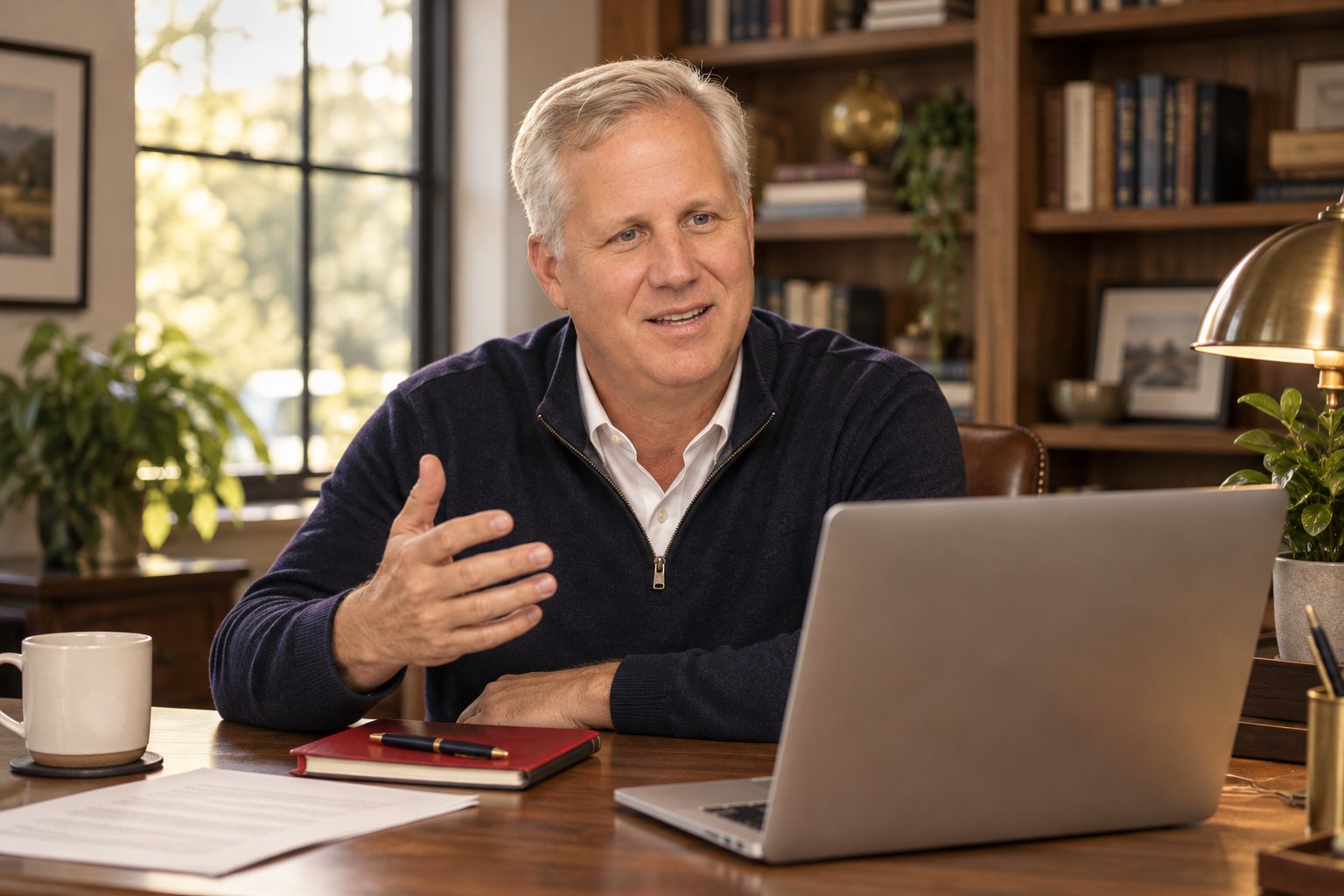
Matt Bramson on a video call at his desk, mid-conversation, a red notebook beside his laptop